
In the Spotlight
Dede Ondishko and the 2026 Memphis Composers Institute
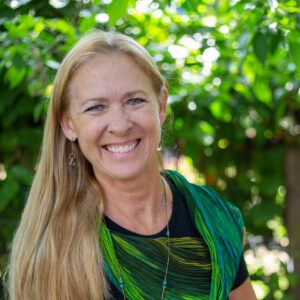
Denise (Dede) Ondishko has been involved with Walden since the 1970s, first as a student, then as a member of Walden’s staff, faculty, and Board of Directors. Based in Cathedral City, California, Dede is a composer, pianist, violinist, jam leader, and all-around creative force.
Ondishko is one of three selected composers who will have an orchestral work premiered as part of the 2026 Memphis Composers Institute (MCI), a partnership between The Walden School, the Memphis Symphony Orchestra, and the Rudi E. Scheidt School of Music of the University of Memphis. Composers in the early stages of their orchestral composing careers were invited to submit an orchestral work for a chance to be performed by the Memphis Symphony. The three selected composers will attend an event in Memphis, from February 1 through 4, 2026, including rehearsals, panel discussions, and a performance of their works by the Memphis Symphony Orchestra conducted by Kyle Dickson.
Dede spoke with us about her experience with the MCI, her creative process, and the impact of Walden on her life.
Tell us about the new work you’ve written, Singing Strength.
In 2011, when I was living on Hilton Head Island in South Carolina, the birds would wake me up in the morning and the frogs would keep me awake at night. At first, I found them to be annoying, and then, living among them for four years, I found them more interesting and decided to get to know them more. I received a grant of $10,000 from the Coastal Community Foundation of South Carolina, which allowed me to buy recording equipment and go out into the field to record the birds.
Together with my field partner, Beverly Gaddy, I went on outings all around Hilton Head Island and throughout the coastal regions of South Carolina documenting birds, insects, and frogs. One night we were out in a graveyard, where we were told you could hear a certain owl at night. It was freezing cold, and we were sitting in my car waiting with the windows rolled down. We got locked in the nature preserve that night, and we didn’t even hear the owl! It takes a lot of sitting and waiting to capture some of these sounds.
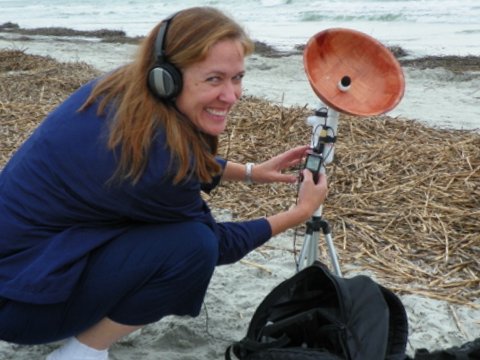
At home, I took all these digital recordings and slowed them down so I could notate the bird calls. I selected the ones I really liked, then start notating them. I have a background in computer music, so my first idea for this piece involved electronic playback alongside orchestra. But I learned that orchestra musicians don’t really enjoy playing along with a tape track, and I realized it would be more interesting to transcribe the birdsongs and frog sounds and have the orchestra embody them. So, I completely rewrote the piece for orchestra alone.
I went to a composers symposium in St. Paul, Minnesota, organized by the American Composers Orchestra, where I did further work on the piece. The piece never got played—all these years I have been wanting to hear it. I am interested in bridging the animal-human language barrier. I have to believe that will happen someday, and this piece is my contribution toward that.
The title Singing Strength reflects that when you have healthy wildlife, you will have a healthy environment. The strength of these insects and birds speaks to the strength of environment. The title comes from a Robert Frost poem, Our Singing Strength.
What do you hope to take from the experience of participating in the Memphis Composers Institute and having your work performed?
One thing is to get a recording of my piece; that’s your calling card as a composer. This piece is written for birders, and I’d love to share it with the birding community and have it performed again. I did my best to notate the birds I was hearing, but I won’t know how close I came until I have the chance to hear it performed.

The other part is the dialogue with the other composers and with the performers. I’m very excited to hear from the performers whether I had other options that might have made the piece work better. It’s tremendously valuable to hear from the performers. I once wrote a piece for wind ensemble, and after the premiere there was a long line of people congratulating me. And then there was one player from the ensemble, a flutist, who was angry because the third flute part only got to play for five measures. That was a good teaching moment. As a composer, I’m thinking of the overall sound, but you also have to look at the individual parts and make sure that each line has meaning.
How did attending Walden impact your path as a composer, musician, and teacher?
Walden had a deep influence on me, making me different from many other composers who haven’t had that experience. When I’m asked the question, “Who were your influences?” I struggle to answer. Because as a Walden student, starting at 14 years old, I colored with the crayons I had in my hand. I wasn’t influenced by anything other than the sounds I had available to me. We were all excited about what we could do with these tools. We bounced ideas off each other—we basically invented our own language. If you study language, how language evolves, most new language is invented by children. In their formative years, they are exploring words and very easily create new words and combinations, and we were doing the same thing with musical language at Walden.
Aside from my Walden training, I trained as a concert pianist at Peabody Prep, went on to Carnegie Mellon, then to Eastman, where I was a composition major and kept performing as a concert pianist. I’ve kept up my piano skills and still perform today. Now in my retirement years, I’ve also taken up Irish fiddling, participating in Irish music sessions and travelling to Ireland to learn new tunes. I also host shows and jam sessions here in California. We mostly do Americana music, and we feature a lot of songwriters. Whenever we have a songwriter, I open up a dialogue about the music with the audience. The audience gets to discover what was in the songwriter’s head when they put it together. And the songwriter gets feedback—what did the audience hear?
I’m retired from teaching but still have private students. I’ve always taught music as a living language. It’s not frozen; we can still participate and create things. All my students have had the pleasure of inventing something that’s completely their own.
Is there anything else you’d like to share with the Walden community about this experience?
I want to say thank you to all my Walden School friends who have stayed in touch all these years. When I finish a piece and send it to my Walden friends, they are very frank with me, because we have such a good background in listening actively and dissecting music. It’s been such a great privilege to be in this community all these years.